
Not good
Yes, the year of 2006 was a hard 12 months for us horror gamers. I mean, sure, 2001 was a pretty bad year. That year, the average score for horror games was below 65%. And 1997 wasn’t too hot either: games like
Nightmare Creatures and Enemy Zero were all that was available. But both 1997 and 2001 saw the release of five games, and while none of them were all that great, horror gamers at least had some selection to tide them over. In 2006, we got one game (or two, if you live in Europe), a catalog more paltry than any other year since 1994.
What have we done to deserve this? In 2005, 15 games were released with us horror gamers as the target audience. On top of that, some of those games really good (like Resident Evil 4). How can the well have dried up so fast?
The answer? “Next Gen.” Those two small words spelled doom not only for horror games, but for all kinds of niche genres. Developers were hunkered down with their new development kits, spending millions on the creation of new titles for the Xbox360, PS3, and Wii. It was time for them to spend more than they have ever spent before on development (as next gen development is much more costly than current gen), but also a time for developers to assume much more risk than usual. The launch of any new console, not to mention consoles retailing at exorbitant prices, can be hard for developers, as the installed base does not yet exist and

Relative sales of survival horror games (North America, all platforms)
Next gen complaints are frequent on this site, so I’ll spare you that particular rant. Suffice to say that in the grand scheme of things, horror games are small potatoes. With the exception of the Resident Evil series, most horror games don’t move enough units to really warrant interest from the publishers. I mean, compared to main stream blockbusters, Resident Evil 4 was a pretty successful game. But the sales of Silent Hill 2, 3, and 4 combined can’t match it. Games like the Fatal Frame series are way behind that. And Rule of Rose? It has sold so badly that it barely even shows up in my graph.
In the context of the video game market as a whole, survival horror is barely a blip on the radar. Horror games are released when niche genres can still do well. That is to say, they are an indicator that risk (and cost) is low. The absolute absence of horror games in 2006 indicates that they are just too risky for publishers to pursue at the moment, especially as the next generation consoles have yet to fall into an obvious ranking. That’s not to say that the genre is dead, just that it’s too small to rate with most publishers. When every release must be a mega-hit to make money, genres like this aren’t even worthy of consideration. But when the market sways back into balance (as it will when the next gen consoles begin to reach a larger and larger audience), we’ll see them return. And the big guns, the Capcoms and Konamis, sell well enough that they can assume the risk presented by next gen.
But we may have to wait a little while until the little guys, the games with new ideas and crazy new game mechanics, are able to return to the market place.
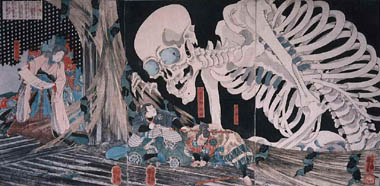 Gashadokuro (pronounced “gah sha doh kuroh”) is a giant skeleton monster from Japan. They can reach huge sizes (up to about 90 feet tall), and are constructed out of the skeletons of people whom have died awful deaths in war or from starvation. The bones are collected into this giant creature by the dead’s feelings of anger at their own grisly demise (yet another application of onnen). The Gashadokuro wander at night, making a “gachi gachi” sound. If they come upon a living person they will attack, often biting victims heads off.
 Rokurokubi is another youkai from Japan. These creatures look and act like normal humans, but at night their necks elongate, freeing their heads to move around almost independently from their bodies. Most Rokurokubi are women, and they take pleasure in scaring regular humans. Rokurokubi are also apparently fond of licking the oil used to light indoor lanterns.
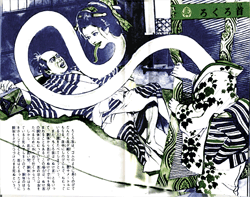 completely detach from their bodies and fly around disconnected at night. Instead of a long neck, the flying, disembodied head is the defining characteristic for this version. These Rokurokubi attempt to hide their bodies at night, and can be killed if their bodies are discovered while the heads are detached.
 Kuchisake Onna (lit. “slit-mouth woman”) is a monster from Japan. Her defining characteristic is her mouth, which extends from ear to ear in a horrible, permanent smile. As the story goes, a samurai mutilated his lover in a jealous rage in order to destroy her beauty. She became a vengeful spirit, and nowadays can sometimes be found wandering the streets wearing a surgical mask. Japanese people often wear such masks during the cold season to prevent others from catching their colds, so Kuchisake Onna does not particularly stand out in a crowd.
 seconds (thats like 75 mph!), and she usually carries a knife or scythe. Men will be killed immediately, while women have their mouths cut, creating a new Kuchisake Onna. Depending on the version of the tale, the only way to escape is to tell the Kuchisake Onna that she is beautiful the second time, or to distract her with fruit or candy.

 came out in Italy (where a ban of Rule of Rose has been proposed), and are far more violent, disturbing, and mainstream than anything in this obscure Japanese horror title. What is it about video games that makes them a target for censorship when other media is not?
 There is a debate among game industry pundits about what games as a medium are about. If you roll with the groups that like to argue academics about video game design, you’ve probably heard of ludology.