This Time it’s Personal


This image turned out to be a hoax, but the fear was real

In March I was visiting Tokyo when Japan was rocked by a huge earthquake and tsunami. In fact, the earthquake itself caused relatively little damage; it was the resulting tsunami that claimed the lives of almost 20,000 people in Northern Japan. To my surprise the news didn’t spend a lot of time talking about the tsunami or its victims. Instead it focused on the nuclear power plant in Fukushima, which lost power due to the quake and experienced a meltdown. In fact, there was quite a bit of nuclear hysteria in the days and weeks that followed. People left Tokyo en masse, American and European news carried reports of threatening “nuclear clouds” that would purportedly carry radioactive death from the Daiichi plant across the Western world; the media followed the plant’s progress with rapt attention. Though the tsunami had wiped out entire towns and devastated Japan’s northern coast, it was the failure of the Fukushima nuclear power plant, to which no deaths were attributed, that caught the public’s attention. The abstract threat of radiation is apparently scarier than the actual destruction caused by a 15 foot wave.

I thought about that for a while. It’s sort of easy to write nuclear fears off as after-effects of the Cold War, a residual phobia rooted in an era in which the dangers of nuclear fallout were drilled into the national consciousness. The effects of radiation are certainly terrible; we know that many of those who died in Hiroshima and Nagasaki were not killed instantly but suffered prolonged, painful deaths. Even a small bit of radiation seems dangerous; after all, it causes cancer, and cancer is a horrible way to die. There have been other nuclear disasters; the Chernobyl explosion caused between 30,000 and 200,000 premature cancer deaths, depending on which report you believe. It’s easy to see why the threat of nuclear fallout, or perhaps contaminated food and water, might cause panic across the globe.

But the more I think about it, the more I am convinced that there’s another lesson about fear to be found in the 2011 Tohoku earthquake disaster. The way that the world glossed over the plight of the tsunami survivors (and the thousands of casualties) to focus on the reactor in Fukushmia isn’t just about nuclear hysteria. It’s the nature of the radioactive threat, something about the idea of an invisible cloud of death spewing from a burning reactor and wiping out everything in its path like some sort of contemporary Black Plague. Whether you lived in Tokyo or San Francisco this summer, the news on your TV screen was suggesting that you yourself might be in danger. Not somebody else in some other town or state or country, but you, the person sitting there in your house right now, might die because of events that took place in some far-off place. The people killed in the tsunami were in the wrong place at the wrong time, but the scary part about some sort of airborne radioactive material is that nowhere is safe, not even your own neighborhood. It’s an intensely personal threat, and I think it causes a very personal form of fear.

In Yes!: 50 Scientifically Proven Ways to Be Persuasive, Robert B. Cialdini et al describe the concept of “social proof,” the idea that people tend to believe that a popular choice is a correct choice. If you can convince a person that people they associate themselves with act a certain way, they too will tend to act that way. To show how powerful the social proof can be, the authors ran an experiment involving the wording of a small sign placed in bathrooms throughout a hotel. The sign originally implored guests to reuse their towels to reduce water consumption in the name of saving Planet Earth. Cialdini changed the wording to suggest that most people who stayed in the room had decided to conserve energy by reusing their towels. He tracked the rate of towel reuse before and after the change, and found that by altering the wording of the sign he had improved towel reuse by 26%. The key was the “most people in this room” bit. By suggesting that other people who stayed in that very same room, people not unlike the guest himself, had reused their towels, he was able to convince more people to do the same.

Like the fear of nuclear fallout, social proof works because it is personal. Popular opinion is much more convincing if it comes from a group to that you include yourself in, whether it be defined by physical location or some other metric. Those Facebook “Like” buttons operate on the same principle. They invite an action while simultaneously reporting the number of people who have taken that action. When you see a Like button that shows 15,000 Likes, all by people who visited the very same web page you did (or so you may assume), the concept of social proof states that you yourself are thus more likely to click that Like button too. Because hey, 15,000 people are probably not wrong, especially if they are browsing the same corner of the web as yourself.

In 1938 a realistic radio presentation of H.G. Wells’ The War of the Worlds, complete with fake news bulletins that interrupted the broadcast periodically, was so convincing that it sent people into a panic. People thought that Martians were really invading the planet. It worked, I suspect, because it portrayed the alien attack as an event happening just down the road. The fake news reports that accompanied the broadcast gave it a dose of realism and caused people to believe that Martians might be arriving at their doorstep in large robotic tripod ships at any time. It sparked fear (and subsequently outrage) because it was too close to home, too personal.

Which brings us to horror games.

At Dakota State’s conference on horror games back in November (which I disgracefully have yet to write about), Jacob Butcher gave a lecture called “Methods of Interactivity in Horror Video Game Narratives.” In it he suggested that horror game often strive for “sympathetic fear,” in which we the player are scared for the life of our on-screen avatar. But a few games also pursue what Butcher called “authentic fear,” which occurs when the game makes us feel that our own lives are actually in danger. Authentic fear is hard to come by, but one way to go about it is to make the game world appear to overlap with the real world. Butcher talked at length about the Manhunt instruction booklet, which looks like a catalog for a snuff film company (Manhunt 2’s booklet looks like patient records–cool!). The idea, Jacob explained, is to make the player a more active participant in the game by casting them as authors (or at least purveyors) of snuff; combined with the handheld-camera kill display featured in the game, the instructions are designed to make you feel uncomfortably close to the content of the game.

I think Butcher is on to something. I mentioned this idea myself while discussing SquareEnix’s DS horror game, Nanashi No Geemu: “[t]he story is about a person playing a corrupted game on a handheld gaming device, and it is presented by giving you a corrupted game to play on your actual handheld gaming device.”

Nanashi No Geemu uses authenticity outside of the game (in this case, the fake DS UI screens and NES-era RPG it contains) to snare the player into accepting the otherwise routine horror content that appears in its main 3D exploration mode. It’s making the experience personal by stepping beyond the normal boundaries of the game, just as Manhunt does with its instruction manual. When I spoke with Deadly Premonition designer SWERY about this game, he admitted that he wasn’t able to finish it. “I was scared that I’d end up cursed,” he told me.

Speaking of Deadly Premonition, it tries hard to be personal too. The way York speaks directly to the us (as “Zach”) makes us feel that we’re an active participant rather than a passive observer. SWERY explained at the 2011 Game Developer’s Conference that York has to shave, smoke, and change his clothing every so often in order to invoke a memory of the game when the player is doing those things himself. SWERY wants to use everyday actions to spark a memory of the game even when the player isn’t playing.

There are other examples, too. The insanity effects in Eternal Darkness that mimic the UI of your TV are designed to keep you (not your avatar, but you) guessing at the legitimacy of what you see on the screen. The use of the Wiimote as a telephone receiver in Silent Hill: Shattered Memories is another attempt to bring the player closer to the game content, as is that game’s “psychological profiling” system.

These systems are not about increasing immersion, they are about increasing personalization. Immersion is when you feel that you are your avatar, but personalization occurs when you are scared for yourself, not just your on-screen counterpart. The radioactive cloud of death making its way into your lungs after crossing the ocean from Fukushima is a personal threat to your well-being. The social proof is a form of manipulation based on your own self-association with a personal group. The fake DS screen is just enough to trick you into substituting the cursed hardware in the game with the device in your own hands. The fake news bulletins and convincing narrative of War of the Worlds was enough to make people fear for their lives. These are intensely personal threats, and they cause a very pure (or “authentic,” as Butcher would say) form of fear.

Here’s to hoping that more games take advantage of this weird, complicated, and by all accounts effective approach.
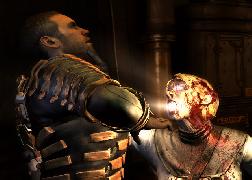
Dead Space 2

I have finally finished another horror game and written a review. This time it’s Dead Space 2, which I quite enjoyed. You can read the review, which turned out a bit longer than I had anticipated. I’ve been itching to write about horror games for months (not to mention the horror conference I attended back in November, but that’ll have to wait for a future post), and it feels nice to get this one out the door.

Part of the reason for the length of the Dead Space 2 article is that I took the opportunity to discuss the concept of negative space. We’ve talked about negative space on this blog for years, but I haven’t had a convenient term for it; the aforementioned Dakota State horror conference gave me this nifty term for the concept. Negative space is the area in which the game (or film, or any sort of narrative) provides clues to some vague, larger structure, but never fills in the details. It is Akira Yamaoka’s “imagination space,” surrounded by clues and incongruent information carefully planted for the player to discover. Negative space is all of the parts of the story that go unaddressed, the bits that must exist and yet are never given actual form. In horror, negative space is of prime importance because it is often home to the scariest of creatures: the ones that we create for ourselves to satisfy the unanswered questions in the story.

At any rate, there’s much more to be said about negative space, but I was happy to have the opportunity to use this useful term in my Dead Space 2 review. Dead Space 2, it turns out, doesn’t have enough negative space, though that’s about its only shortcoming.

Happy Halloween

Happy Halloween, folks!

I mentioned in my previous post that I would soon return to a regular posting schedule. I know, it’s a promise I’ve made before, and one that is increasingly difficult to keep. For this post, let me tell you about what I’ve been up to for the past six month that has prevented me from really tearing into the flesh of the stack of horror games sitting on my shelf.

As I mentioned a few months back, I left my job at Google this year to found an indie game studio called Robot Invader. Over the last five months we’ve worked our butts off to get our first game finished. It’s a title called Wind-up Knight, and we launched it on Android last week (check it out on Android Market). An iOS version is coming soon. Wind-up Knight has eaten 110% of my time–my sleep schedule (and that of my other cohorts at Robot Invader) dipped into the “less than five hours per night” range for a while there. Now that the Android version is out the pressure is starting to ease, and I’ve managed to put a few hours into Dead Space 2 this week.

But my schedule is one that drinks a lot of coffee and doesn’t like taking breaks. Tonight I fly to Montreal to speak at the Montreal International Games Summit, both about Android games and a little bit about horror as well. On Wednesday I leave Montreal and fly to South Dakota for Dakota State’s conference on horror games, where I’m giving a keynote. Saturday evening I return to the San Francisco Bay Area, where hopefully I can relax for a day or two before stuff gets crazy again.

All of this is a long excuse for not writing more about horror games. I shall soon write something about the content of my horror mini-talk at MIGS, and my keynote at Dakota State. Then maybe I can play some horror games again. That’d be nice.

Sweet Home on Destructoid

Destructoid has an extremely through write-up of Sweet Home, the best I’ve seen. It’s also the most information you can find about this game in English, as far as I can tell. If you are interested in the history of the Resident Evil series, or want to see how horror games on the NES work, check it out.

PS: I am not dead, only sleeping. Actually, I’m not sleeping at all, and that’s the problem. Updates to resume soon, I promise.

Biometric Analysis of Horror Games

Gamasutra is running the most complete biometrics study of horror games that I’ve seen. It’s fascinating research, and the end page of conclusions is particularly useful for the horror game designer. Most interestingly to me, the study finds key differences between how “core” gamers and “casual” gamers are scared. Core games see through scripted sequences and are less scared by them; casual gamers are not as familiar with the language of games and are thus more affected by scripted sequences and cutscenes. Alan Wake and Dead Space 2 were effective with both groups, but Condemned was more effective with core players than casual. This is great stuff, check it out.

Corpse Party

Hey, remember I wrote about Corpse Party last year? Turns out it’s actually coming to the US in English. It’s a pretty well-done game, at least based on the first couple of hours that I played. Don’t let the top-down JRPG interface fool you, there’s some pretty high-tension scenes here. That said, the whole thing is done with a bit of humor and doesn’t take itself too seriously. It’s very much a sort of teen horror flick rendered in game form as a top-down RPG.

Playing PC Games is Hard

One of the most contentious aspects of this site is my decision not to include PC games in the Quest. This decision is not borne of some hate for the PC as a game machine, as some have supposed. Nor does it stem from some imagined key difference between PC horror and console horror. You would not believe how much e-mail I have received over the years asking why I am snubbing games like System Shock, White Day, Clive Barker’s Undying, the Penumbra Series, The Path, Amnesia: The Dark Descent, Phantasmagoria, 7th Guest, or even obscure titles like Realms of the Haunting. My choice not to include those games has been the source of much internet angst over the years.

My rational, as explained briefly in the about page, is that PC games represent too wide a spectrum. To draw real results, I need some sort of focus in this research project, and the decision to concentrate on consoles over PC has to do more with setting actually achievable goals than the content found on those respective platforms.

There is another important reason to exclude PC games from the Quest. It’s simply impossible to play the majority of them any more. First, I don’t have a Windows computer. But even if I did, I’d need one running the latest version, one running XP, one running ’95 or ’98, and probably one dedicated DOS box. I’d also need a System 6-era Mac, a 7.1 Mac, a 7.5.5 or 8 Mac, etc. Not to mention the other sorts of obscure computers I’d need to keep around just to play the odd niche title that came out to limited success in 1984 or whatever. Games tend to bit-rot very quickly, and as versions of operating systems and video drivers change, it’s usual for games to simply stop working after a few years. And since games bit-rot so quickly, it’s pretty hard to actually buy old games for PC–even the used market is pretty slim. Logistically, including PC games doesn’t make a whole lot of sense. The cost / benefit ratio is too low.

This is the point in the argument where some smart-ass pipes up and asserts that virtualization can solve this problem. Virtualization is the process of running an operating system within another operating system, booting one OS up inside a little region secretly controlled by a real computer. This can be a form of emulation (if the virtual hardware differs from the host machine), or it can simply be a way to boot old software on modern chipsets. You can run Windows in a window on your Mac, for example, with software like Parallels or VMWare Fusion. You can run Windows applications from Linux with software like WINE. In theory, it should be possible to take whatever hardware I’ve got (a Macbook Pro), get the right emulator or virtualizer software, install some ancient OS on it, and then play old games. And in practice, this is probably actually feasible. But it’s not easy, and it’s not quick.

Let me give you an example. A while back I ran across an original (unopened!) copy of The Last Express, a game that frequently makes top-10-adventure-games-of-all-time lists but didn’t actually sell that well when it came out. The Last Express is a game by Jordan Mechner (Prince of Persia, Karateka), who is one of my game development heroes, and I have wanted to play it badly. This game came out in 1997 for PC and Mac (hybrid on one disc). 1997 wasn’t that long ago, right? I went to college in 1997. I should be able to make software from that era run, right?

So what are my options? Well, popping the disc in my Mac brings up the Mac partition, which is a PowerPC executable binary. Apple had a PPC runtime translator called Rosetta that came with the OS, but they deprecated it for the most recent release, which of course I just upgraded to. If I want to run the Mac version, I’m looking at a PowerPC emulator. There are a couple (PearPC seems to have come back to life, but doesn’t have OS X binaries). I tried Sheep Shaver, which let me boot into Mac OS 8 (it brought a tear to my eye to see that UI again), but wouldn’t run the game (it crashes immediately). Well, my Mac is an x86 device now, so maybe running the x86 binary is a better idea. I tried DOSBox, which is purported to run The Last Express, but it can’t see the PC partition of the CD. I spent the better part of three hours experimenting with different ways to mount that separate partition to no avail. There’s Cross Over, which is a WINE wrapper for Mac that lets you run some Windows games without actually having to install windows. I downloaded the trial, and while it was able to run the installer without issue, the actual game didn’t run at all. There’s VirtualBox, which will run Win95 or 98, but those are unsupported and to use it I’d need to go buy a copy of ancient Windows somewhere (remember product keys? yeah). After a couple of hours of reading online I realize that others have successfully ripped isos of the CDs that I legitimately own in such a way that DOSBox can see both partitions (apparently this game has some interesting copy protection mechanism that makes this operation difficult). A torrent later I have iso versions of the CDs sitting on my desk. These I can mount in DOSBox, and get the Last Express installer to run. The game doesn’t work though–to solve that I actually needed to manually copy some files from the CD into a specific location that people with too much free time discovered. So now the game runs (hooray!) but the colors are all screwed up. Another set of searches reveals this to be a Mac-only problem, and one that nobody has a fix for.

Long story short, virtualization does let me run this game. It cost about as much time as beating the game itself will probably take me. And none of the setup I performed will be particularly useful in running the next game–each case is specific and problematic in a different way.

So now I’m looking forward to playing The Last Express, albeit through a bright green-tinted lens. But this is pain that I cannot abide by very often, and is certainly not worth the time for the thousands of other potential PC horror games out there. So, I stand by my assertion that omitting PC games is a reasonable restriction; though it might slightly warp my understanding of the genre, the logistics involved are simply too time consuming. Better to have a warped view based on the (not insubstantial) console catalog of horror games than waste time trying to get ancient software to work and have no view at all.

The Internet as Horror Media

A couple of years ago I attended a lecture by comics researcher (and artist!) Scott McCloud, which I throughly enjoyed. McCloud is interested in how comics work–he calls them “sequential art,” and his books are fascinating dissections of the fundamental artistic techniques upon which that medium is based.

One of McCloud’s recent interests is the use of comic books on the internet. Web-based comics are interesting to him from a monetization perspective, but he also talks about the use of space for art that is not bound by the borders of a physical page. At his lecture, he showed examples of comics that scroll left to right in a really, really long window, but don’t actually require any clicking. His point, I think, is that when freed from the constraints of a physical page, comics have the opportunity to really flex their muscles as an art form.

Today I ran across something that would make McCloud pretty happy. It’s a short horror comic in Korean (second post about hangul this week!), and you can read it by scrolling down. You don’t need to read the language to enjoy it. You do, however, need sound.

Did you read it yet? Click the link now and come back when you’re done (assuming you are not balled up on the couch after that).

This is similar to Red Room, which I referenced briefly in my feature about Japanese horror. It’s using its medium–an internet web page–to dramatically increase its scare effect by doing something you do not expect. Red Room is harder to enjoy if you can’t speak Japanese, but the mechanics are similar; after setting the scene about an internet-based viral curse, the game springs the same trick on your browser that killed the story’s main characters.

What is so fantastic about this comic and Red Room is that they are utilizing their medium to do things that you do not expect them to be able to do. Sure, it’s a pop-out scare, but it’s effective because it pops out of your screen, right at you, through your browser. Unlike the zombie dogs crashing through the window to attack your avatar in Resident Evil, these sites are targeting you, the viewer, directly. If you can’t trust your own browser, what can you trust? By breaking the normal rules of the web, these pieces are putting you squarely in a position of lost control. And that’s where horror is best.

Recursive Unlocking, Now in Korean

I got a lot of positive feedback about my article on the recursive structure of Resident Evil’s map design, but the highest praise comes from a user named 9L, who translated my entire feature into Korean. I can’t read Korean (maybe some day), but I assume that translating a long text about game design and the use of data visualization to uncover patterns in Resident Evil’s Spencer Mansion is a lot of work. A whole lot of work.

You can read the article in English if you want, but if you prefer, the Korean version is pretty slick. Thanks very much to 9L for the major effort!