Crap, it’s already April 2?

So I missed April Fools this year. Sorry. My excuse is that I was on a plane over the Pacific, which is true. Next year I’ll have some totally mind blowing joke prepared for you all (I considered posting that Alan Wake had been announced as an iPhone exclusive, but I figured that probably won’t have gone over well).

I have a post in the wings about The Path. The short version is that you should go buy it. While it is in many ways a classic adventure game, it’s been filtered and twisted and it’s like nothing that you’ve seen before. It’s a different kind of horror game, one that will require you to think. I’ve only spent a few minutes with it but that’s more than enough to recommend it to you here. I’ll have a much more in-depth post about this game when I get to spend a little more time with it.

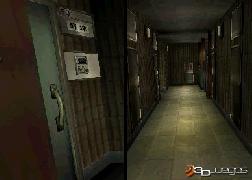
Last week was also GDC, and there’s been some horror-related news to talk about. Here’s some screenshots from the new Silent Hill remake, which looks, uh, odd. I’ll play it, and I’m very happy to see that somebody is finally using the Wiimote as a flashlight (ok, Fragile did this first), but I can’t tell much about it yet by just looking at the screenshots. Also, I was surprised to learn that the Saw game is still in development (apparently Konami is the new publisher), and even more surprised that there are screenshots available. The database is quickly falling out of date!

At the end of the month I will be speaking at the Thinking After Dark conference. The list of speakers is impressive, and the topics are all things I am interested in, so I am quite excited about attending. Any of you in upstate New York or Montreal should come attend!

The Survival of Survival Horror

There’s a pretty great article over at GameTopius called The Survival of Survival Horror about the way that modern survival horror games resemble their predecessors. The author, Thomas Cross, draws a line in the sand between games like Dead Space and Resident Evil 5, and Siren: New Translation and Silent Hill 5. His point–which is one I’ve attempted to make here before as well–is that the difference between these two types of games has less to do with the way that they are controlled or the amount of action they contain than the pacing and moment-to-moment game strategy that these games encourage. Cross also expertly points out that while both RE5 and Dead Space are action-oriented, Dead Space is very clearly designed to scare the player (though it’s success in that respect is sometimes damaged by its approach to combat pacing).

This is a very important distinction, and I like how Cross has called RE5 and Dead Space a new “quadrant” of survival horror. As we discuss the evolution of the modern survival horror game (which has been a hot topic here lately), I think that noting that these new games differ dramatically from each other (and from those of the past) is key to understanding how the genre is changing.

Give Cross’ article a read. It’s well-thought-out and quite timely.

Brain Dead Space

When I was a kid some developer realized that with the advent of the 2x CD-ROM drive you could stream really tiny, really crappy video off the CD onto a PC. This lead to an explosion of universally-terrible “interactive movie” games like The Journeyman Project and Spaceship Warlock. Though the genre probably contributed to the advent of good games like The 7th Guest, Phantasmagoria, and Myst, there were a couple of years where the genre was entirely crap. One of these games was called The C.H.A.O.S. Continuum, and it was yet another click-randomly-until-you-win type of game. I saw an awesome, one line review for The C.H.A.O.S. Continuum at the time that simply read, “Great graphics, but where’s the game?”

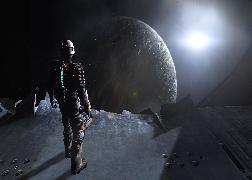
Dead Space isn’t that bad by any stretch of the imagination, but it reminds me of The C.H.A.O.S. Continuum. The production value for Dead Space is off the charts, the game play is fun, and there are some neat innovations to be found in the game. It’s just that the whole thing is so slick that you can pretty much zone out and play it through without the need to think anything through. It makes sense to me that the next Dead Space game will be an on-rails shooter; the first sort of felt like that to me as well.

Dead Space is a good game, but it’s not a fantastic game. At least, I don’t think so. You can read about it in my full review.

I Hate Optional Mini-games

I can’t stand ’em. I have no problem with mini-games per se; it is specifically optional mini-games that get my goat. You know what I mean, the kind that you can skip without hurting the game but if you play all the way through are guaranteed some sort of reward. Like the shooting gallery game in Resident Evil 4. Or the, uh, shooting gallery game in Dead Space. The Shenmue series is one of my favorites of all time, but it is a serious offender in this category; though the games include required mini-games (which I have no quarrel with), they are also chalk full of optional challenges that don’t need to be completed to finish the game.

These mini-games follow a pattern. The challenge must carry some sort of reward, otherwise it’s just a way to waste time. You know that when Isaac in Dead Space interrupts his attempts to get off the alien-infested ship so he can partake in a little zero-G air ball, it’s because he wants to get some big reward at the end. Even worse are the games that rate you behind the scenes; it’s like, you finish the game, and the screen says “Congratulations on finishing the game. However, you failed to find all of the furry bunnies. Your rank is E-.” I hate that. It’s bullshit. If they wanted me to find all the bunnies then then should have made that part of the required conditions for winning. Look, I am sorry that I failed to carry out all of the books in the goddamned library without dropping any of them three days in a row, Master, but could you please give me your special advice that you promised anyway so I can get on with the freaking story?

Here’s the problem with optional challenges: they are very rarely ever the same level of quality as the rest of the game. When development teams responsible for these games see their deadline approaching, the optional mini-games always take a back-seat to the rest of the content because, hey, it’s optional. Required games, on the other hand, get played by the team a lot more because they are required for progression, and as a natural consequence they end up being a lot more fun. Carrying books out of a library? LAME. Catching leaves from the tree outside the library between your fingers. AWESOME. That’s how it always works–optional content always loses out to the required content when time is short and push comes to shove.

Now the real deal-breaker, at least for me, is that optional challenges are not really optional. I want to beat the game, and that means BEATING THE GAME. I mean all of it! I got stuck for about three months on the original Shenmue because I refused to progress in the game until I had achieved first place in the forklift race mini-game. You know what, that mini-game sucks! If you so much as brush a wall with your forklift your velocity instantly goes to zero and you have immediately lost. I played that stupid thing about one hundred times, to the point at which I was able to get second place every single time, and yet I never, not even once, came in first. Finally a friend beat it and discovered that the great reward for such a difficult challenge is a miniature forklift item that says “first place,” at which point I gave up and just played the rest of the game out. The shooting game in Dead Space was probably intended to be a fun diversion, maybe a way to give out an achievement or something, but I spent an entire hour beating that stupid thing. It wasn’t fun, it wasn’t ultimately rewarding, and it didn’t “break up the game play” in a good way. It was a challenge that I decided to complete, and when it was done I swore one last time and moved on with nothing to show for it but a new power node.

So, to bring this rant to a close. Developers: make your goddamn mini games required for progression. If you do that and your game is no longer fun, it means the mini games suck. Fix them or cut them. Just, whatever you do, don’t make them optional.

Dead… Space?

I’m playing through Dead Space at the moment. Well, more precisely, I’ve been playing through Dead Space for close to three months. I am having a lot of trouble staying interested in it. This is kind of surprising to me because there’s really nothing wrong with the game at all. It’s a model of modern game design, the technical execution is fantastic, and there’s even been significant thought put into the systems that are responsible for most of the horror content (the sound system is great). But for some reason I just can’t be bothered. I mean, there’s nothing wrong with the game, and playing it is fun and all, it’s just sort of uninspiring for some reason.

Sometimes, a game comes along that is fatally flawed in a certain way but also has a spark of brilliance. Indigo Prophecy (aka Fahrenheit) was like that for me. The game had a vision, and it was pretty well executed, but at the end it totally fell apart. But the vision alone carried the entire experience; even though the last third or so was pretty shoddy compared to the initial experience, I ended up really liking the game. Hellnight is a similar story: the graphics are bad, the controls are dated, the collision detection is wonky, and yet the whole thing is held together by a few genius design choices.

Dead Space feels like the exact opposite of that phenomenon. There’s nothing wrong with it–nothing at all. And yet, there’s no spark of brilliance either; it’s very, very well executed, but ultimately fairly routine. It’s even pretty innovative for this kind of game, and yet the innovations, while good, are all minor improvements over a well-defined formula. There has yet to be a moment where I see the hand of a designer with a complete vision of the experience moving behind the scenes. Dead Space is really slick, but it feels like it was built by robots who were programmed to know the core features of all horror games. There’s just no character to the game.

I’m not finished with Dead Space, so the game may yet prove me wrong (that’s certainly happened a few times before). I will hopefully finish it off in the next week or two, at which point I will have to figure out a way to write a review for a game that is perfectly executed and yet somehow lifeless.

Eversion


It goes downhill from here.

Lately Nanashi no Geemu has got me thinking about how horror operates at a fundamental level. One of the keys, it seems to me, is connection with familiarity. Silent Hill uses normal, every day locales (an elementary school, a mall, an apartment complex) and then taints them with monsters, death, and eventually decrepitness. Nanashi No Geemu’s cursed RPG works the same way: it evokes a feeling of familiarity in the user–an involuntary feeling of comfort–and then twists that feeling into something much more sinister than it really has any right to muster. I ran across another game this evening that strikes me as an excellent example of this theory.

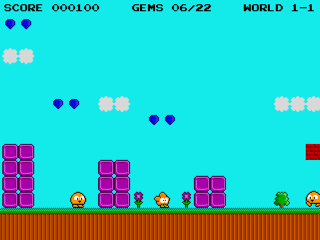
Eversion is a light, Mario-esque platformer. It has happy music, 8-bit graphics, and a unique game mechanic. It’s unfortunately only available for Windows (though it ran without error on my Mac via Crossover). At first, it seems like somebody’s cute attempt at 1980’s era platforming game play. But very quickly it becomes clear that the game has an agenda and it’s not all blue skies and happy flowers. I won’t ruin it for you, but give the game a shot. It gets pretty hard but I advise you to stick with it. Be sure to ignore the comments on the main download page, as they will spoil it for you.

Eversion works very much like Nanashi No Geemu in that it lulls you into a comfortable zone with a familiar style. It also twists its particular knife pretty slowly; it’s not until the fifth or sixth level that you really realize how carefully the entire thing has been planned. But the result is pretty neat, once again proving that horror does not require high-end graphics tech to be effective. (Interestingly, the game also adds more weight to the idea that sound plays a much more important role in the creation of tension.)

So, another ingredient of successful horror games: familiarity as a way to surprise the player. Not every title does this, but I think that a number of the really good ones do.

Nanashi No Geemu

I have completed Nanashi No Geemu, SquareEnix’s Nintendo DS horror game about a cursed 8-bit RPG, and posted a review. The game is a paradox. On the one hand, the game play is extremely shallow and repetitive. On the other hand it’s amazingly innovative and, at times, genuinely scary. Excellent execution of a mediocre idea, or mediocre execution of a great idea? I am not sure exactly with this one. In any case, read the review for details.

20th Century Boys

This is a bit off-topic for this blog, but I wanted to make comment about the film adaptation of 20th Century Boys (20世紀少年) a pretty killer manga by Naoki Urasawa. The manga is about Kenji, a regular joe convenience store owner who realizes that a story he wrote as a child about the destruction of Tokyo is being used as basis for an insane terrorist plot. The manga is very long and quite complicated; it jumps back and forth between present-day Japan, Japan in the near future, and Japan in the early 1960s. There are a great many characters and the connections between them are hard to keep track of. But the whole thing is fascinating, both because it’s a high tension drama about a single man’s attempt to stop a madman that everybody else seems to love, and because it shows how the central characters age and change over time. It is not, I would think, an easy work to convert into a film.

However, having watched the first film a few weeks ago (which covers about the first 1/2 of the story; the second film is in theaters here now), I am greatly impressed by the extreme care with which the story has been adapted. There are a few minor changes, and more than a few unnecessary scenes have been trimmed, but fundamentally the (quite long) film hits every single major plot point from the first half of the manga series perfectly. The characters are all there, and the actors and actresses portraying them have been so perfectly selected that most characters are immediately recognizable. This is, hands down, the most faithful adaptation of any comic, video game, or book to film that I have ever seen (the first couple of Spider-Man films were pretty faithful too, but they have nothing on 20th Century Boys). It’s as if the director sat down with the comic panels and used them directly as his story boards; with the exception of a number of omitted scenes, it’s pretty much all there.

The problem is, I get the feeling that the film will make absolutely no sense to viewers who are not already familiar with the manga. The transitions from scene to scene, from time slice to time slice, are too abrupt and arbitrary; in the original comic there were plenty of pages of exposition to ease the reader from one theme to the next, but the film has so many bases to cover in such a short amount of time that it is reduced to a collection of almost unconnected scenes (although each scene itself is quite good). Clearly the film suffers from its short time limit, even though it clocks in at two and a half hours. There’s just too much story to tell, and while a series of three films might have made more sense length-wise, the plot is very easy to divide in half and very hard to divide into thirds.

So I am left wondering if a work like this can be translated to film properly. Stephen King is famously hands-off when it comes to films based on his work because he believes film to be fundamentally different than writing, and he leaves it in the hands of his directors to render his works in screen format. But then again, almost all of the movies based on Kings works are terrible (though it’s worth mentioning that the non-terrible ones are absolute gems). In the case of 20th Century Boys, the director has been absolutely meticulous in the translation of the manga to film, and yet the result feels disjointed and off-pace. When I went to see the Silent Hill film, the friends I was with were evenly split about the first fifteen minutes: those who have played the games loved the well-executed film recreation, and those who had not played the games found the intro long and boring. I’ve yet to see the Siren film that came out here in Japan, but I suspect that it will be pretty bad if it just tries to recreate the plot of the game; there’s too many characters and too much cyclical interaction for the story to play out well linearly. Maybe the approach of the first Resident Evil film, which used the main characteristics of the series as its thematic basis but then presented an original story, is the better way to go (that film is unfortunately also pretty bad).

This is, perhaps, an area where games are closer to literature than to film. A game has a very long time to present its story, and details can emerge at a rate much slower than in a film. Maybe the reason that game stories suck so much (David Cage likened them to porn film plots) is that film-length tales are being dragged out for 10 or 20 hours when they really only have enough content to sustain two hours. Hmm, a new theory to consider.
LIT

Thanks to forums member faDeD for turning me on to a new WiiWare horror/puzzle game called LIT. I haven’t had time to play it yet–as you can probably tell from the dearth of posts recently, it’s been a busy month–but it looks like a lot of fun. I am keenly interested in how horror games might perform on services like XBLA and WiiWare; I suspect that the types of horror/adventure games that are being made for DS could work on these platforms really well, for about the same development cost. And damn it, somebody has to make a proper point-and-click adventure game using the Wii remote (to be fair, there are a couple of attempts already).

I am trying to decide if I should loosen the Quest criteria to include hand-held games. I am still working my way through Nanashi no Geemu (damn, that game needs save points), and with titles like Silent Hill: 0rigins already in the wild it seems like it might be a good move. I initially omitted hand-held games because there are very few portable horror games and I didn’t want to have to track down every last NeoPocket or Wonderswan to complete the Quest. But it seems like the only real contenders are the PSP and the DS, and even then most of the titles are on the DS. So maybe I should go ahead and count games on those platforms–they are certainly relevant from a content perspective. What do you think?

Us niche blogs gotta stick together

A friend sent me a link to a crazy blog this evening. Cunzy1 1’s Dinosaurs in Games blog is blog in which the author is attempting to catalog (and rate in terms of scientific accuracy) every instance of dinosaurs (or dinosaur bones) appearing in video games. The site was sent to me because his most recent post is about a project I worked on last year, Google Lively, but I love the site as a whole because it’s so focused and niche. Cunzy1 1 is clearly an expert in this field, and though the blog is still pretty young, it’s clearly a labor of love (and yes, he’s got Dino Crisis covered). I can relate to blogging about an extremely focused topic, especially one that is related to games, and Cunzy1 1’s Dinosaurs in Games blog made me smile. Check it out.