The pretty great-looking Penumbra: Overture is now getting a sequel, which looks pretty neat. Destructoid has the scoop (as well as a video), and there is more info at the official site. I don’t have a PC and thus wasn’t able to play the full version of Overture, but the demo seemed very neat. I liked how the developers used physics to force the player to actually perform actions within the game world; that seems like it could be an interesting axis for horror, and the trailer for the sequel seems to really play that aspect up (analog control over doors, etc).
New Silent Hill 5 Footage
Destructoid has some new footage of gameplay from the upcoming Silent Hill 5. Everything about it looks pretty good except for the camera; it looks to me like it’s a standard American third-person-on-the-second-stick camera rather than the rather brilliant camera system from previous games in the series. I hope that I’m wrong and that the Collective has a system just as awesome as the previous games (cue slight rotation to the left as I approach this door) in the works.
In Defense of Bad Games

Kuon: a terrible game.
So I want to talk a little about why playing and critiquing bad games is so important. My goal is not to take the development teams to task; in my career as a game developer, I’ve worked on some pretty poor games myself, and I know first hand that bad games are almost always the result of factors outside of the development team’s immediate control rather than incompetence. So while I may bitch about how certain games are badly balanced, or too tricky for their own good, or fatally flawed, I am blasting the game experience, not the people who made it.
In fact, I think that my experience working on games that turned out to be less than stellar has a lot to do with my rationale for running this site. You can’t help but wonder what the hell happened when you play something like The Ring for the first time; everything is so amazingly broken that it’s almost hard to pin down which of the game’s failures is the most glaring. I think that one of the big reasons that bad games get made is that people experiment with ideas but do not have time to change or refine them if they don’t work out; the Ring might have sounded good on paper, but the development cycle was probably so short that even if the development team realized that they had just created the worst thing ever in the history of things, they probably didn’t have any time to go back and make fixes. I’ve been there, and it’s a sucky situation to be in.
So one of the reasons for me to run this site is to find out what ideas really don’t work so well so that maybe other developers can avoid them in the future. Given that game development time is limited and a lot of things have already been tried, I’d like to provide a resource for game designers (or anybody interested in design, even if they are not a professional) to examine what has been done in the past within the horror genre, and which of those ideas have failed.
To that end, playing bad games is much more enlightening than playing good games. So often a game works very well because many aspects of the game design work together to produce an excellent experience. It’s hard to tell, then, which of those aspects might work outside of its original context; it’s hard to divine which parts of a good game are intrinsically good, and which parts are good because they’ve been combined with other design ideas. But by playing bad games, you can quickly and easily get a feel for ideas that do not work. If these are ideas that have been successfully employed elsewhere, that tells you that the idea isn’t robust enough to stand up on its own, but it can work when combined with something else. Playing bad games also helps me appreciate the quality with which good games are developed; after playing Kuon, I have new respect for the highly superior (and somewhat thematically similar) Fatal Frame series.
So I love bad games. I started this site to learn about why good horror games are good, and that means I also need to understand why bad horror games are terrible. Even though it can be a chore to play them, and any enjoyment I get may be in spite of the game rather than because of it, bad games are an invaluable resource.
Silent Hill: 0rigins coming to PS2
Kotaku is reporting a fairly substantial-sounding rumor that Climax and Konami will be bringing Silent Hill: 0rigins to the PS2 in 2008. Makes sense–ports are pretty cheap and the PSP isn’t exactly a money-making machine. Here’s looking forward to a PS2 port of the latest addition to the Silent Hill series.
Feature: The Changing Utility of the Otherworld in the Silent Hill Series
 I’ve posted a new feature with a lengthy title: The Changing Utility of the Otherworld in the Silent Hill Series. This article is about how the use and meaning of Nowhere, the Otherworld that appears in every Silent Hill game, differs from game to game.
I wrote this after thinking about how Silent Hill: 0rigins’ use of the Otherworld really changes its effect on the game (which I touched upon in my review). After thinking about it for a while, it seems like the effect generated by the Otherworld is actually pretty different in each of the Silent Hill games; the same basic mechanic is being used in different ways with different results. So in this article I tried to explore what some of those uses are, and how they affect their respective games as a whole.
Cold Fear Leaves Me Cold

Blood? Check. Gore? Check. Fun? Nope!
While the game does improve once you move from the ship to the oil rig, its lack of map, horrible save point system, and unpredictable ammo rationing approach pretty much doom the entire experience. Don’t even get me started on the end boss–what a load of crap that section was.
I know a lot of you guys enjoyed this game. What I’d like to know is, why? What did you enjoy about it? I had a really hard time thinking of anything other than the graphics and presentation that I thought was well done.
Retribution
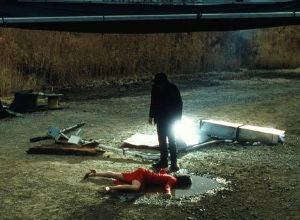 The other evening I watched Kiyoshi Kurosawa’s latest, a film called Retribution (sakebi, or “Scream,” in Japanese). You may remember that I am a pretty big Kurosawa fan; his film Cure is one of my favorite horror films of all time. The others of his that I’ve seen, Doppelganger, Pulse, Charisma, and Seance, are also excellent, though they are not as absolutely inspired as Cure. Kurosawa is good at using long, wide shots that go on for seemingly forever to convey the emotions of the protagonist (which, in his films, is usually isolation and despair). Kurosawa is a horror film director who actively avoids simple plots and cliche devices in his films; there is a subtly and sense of careful measurement in everything that he makes.
Retribution is no exception. The film revolves around a police detective working on a murder case and slowly realizing that the perpetrator is probably himself. It is a fatalistic film, very similar in tone to Kurosawa’s earlier Pulse, with a few little details from Cure thrown in as well. Kurosawa has something to say about Japanese society, something about the bleak isolation that Japan’s constant development and focus on the future creates. When the protagonist detective (played by Koji Yakusho, just like in every other Kurosawa movie) begins to see the victim of the crime he may have committed in his apartment, the effect is less ghostly than it is desperate. The visions that haunt him seem like pretty standard horror stuff early on, but by the end of the film the dead girl is something other than a run-of-the-mill vengeful spirit. The feeling of desolation and poverty within the world’s second richest nation is reinforced by the locales and sets that Kurosawa employes. Everything throughout the film is decrepit, dirty, and old, even locations that we might normally associate with modern society, like the police station. Recurring earthquakes and endless shots on reclaimed land also remind the viewer that the foundations upon which modern Japanese society is built are not necessarily stable.
Retribution has its flaws (well described in this extremely detailed, very well thought-out review of the film), and I enjoyed it slightly less than Kurosawa’s previous works, but that said I still thought it was pretty great. This kind of film cannot be made in America (not by a major production company, anyway), and I am thankful that we have guys like Kurosawa around to make it.
Sexuality as Fear Enhancer
 In my review of Haunting Ground, I argued that the over-sexualization of the protagonist hurt the game’s ability to be scary. My point was that the bouncing breasts and mini-mini skirt that follow Fiona around throughout the game amount to fan service, and ultimately distract from the game’s primary goal of being scary.
Leigh Alexander, author of the weekly column The Aberrant Gamer, thinks otherwise. In her recent column about Haunting Ground, Alexander argues that portraying Fiona as an obvious sex object serves to heighten the player’s sense of fear because we understand that the game’s antagonists are also thinking of her this way. The cost of failure is very high for Fiona, as her assailants seek not only to kill her, but to violate her in terrible ways as well. This, Alexander argues, puts Fiona in an even more vulnerable position than she might otherwise be in, which makes her easier to be scared for.
This is not an angle that I had previously considered. If you are interested in this sort of thing, the article is a good read.
Silent Hill 0rigins Review
I finished Silent Hill 0rigins the other day. It’s a solid Silent Hill game, absolutely worthy of inclusion in the series. Though it’s technically a prequel to the original Silent Hill, it plays like an amalgam of every game in the series. The locations and progression through Silent Hill are very similar to the original game, many of the graphics effects (like the fog and shadowing system) are taken directly from Silent Hill 2, the monster designs are a mix of the second and third games, and there are even a few aspects of Silent Hill 4 thrown into the mix (voyeurism via holes in walls, chargeable melee combat, weapons that degrade with use). There’s an analog for Pyramid Head (though he can’t approach the awesomeness of the original triangle-topped antagonist from Silent Hill 2), extrapolation of the monster design themes defined by Silent Hill 2 and 3, and a (somewhat awkward) story line involving both the cult from Silent Hill 1 and 3, and an introspective protagonist working his way through manifestations of his own problems.
And, as a mixture of four awesome games (well, three awesome games and one mediocre one), it actually works pretty well. The game play in general will seem intensely familiar to anybody who has played a Silent Hill game before–everything from the rate at which maps are completed to the placement of health drinks in doorways and alleys throughout the town has been duplicated with meticulous care. It’s almost pointless trying to describe it; if you’ve played any of the first three games in this series, you know exactly, down to the very last detail, what to expect.
There are only a few minor points at which the game differs from its predecessors. Combat is similar to Silent Hill 3, except that charging hits (per the fourth game) has been added and there is a mechanic for new, one time use weapons (heavy things you can break over enemies’ heads). Some monsters are now able to grapple, and a key sequence mini-game is required to get them off without taking damage. Weapons also break after you use them for a while (an amazingly short while–three or four hits sometimes), so you have to keep picking up new bludgeons as you move around the world. But fundamentally, even the combat feels pretty much exactly the same as the previous iterations. It even suffers from some of the same problems as the earlier games: the bosses are all trivially easy as long as you save your guns, etc (at least there’s no giant moths in this version).
The other major change to note is the way that the character accesses the Otherworld; unlike previous games, Travis can switch from one world to the other at will as long as he has access to a mirror. This changes the role of the Otherworld somewhat–it becomes part of the larger traversal puzzle gameplay, rather than being a dramatic plot point. I have more to write about the Otherworld, but I’ll save it for a different post. Suffice to say that the implementation in Origins, while different, works well.
As the story line goes, it’s a little bland. The story in Silent Hill 4 was pretty bland as well, I thought, but the previous games, particularly Silent Hill 2, had excellent stories to tell. The problem with the story in Origins is that, like the game play, it’s just an mixture of things that have already happened in the previous games. While that sort of dedication to the precedent is welcomed for the game play, it makes the story fairly predictable, and drains it of some of its life. Also, while the level design does an excellent job of building tension, sometimes the payoff seems weak (particularly, the fight with the Pyramid Head knockoff was pretty anticlimactic). Also, the protagonist himself is a pretty thin character; though we learn about his life while playing the game, we learn almost nothing about his personality or feelings as an adult. I mentioned in my initial impressions that I felt like he didn’t comment on his situation enough, and now that I’ve finished the game, I think that being so stoic hurts the game’s ability to make him a convincing character.
But really, I have very little to complain about here. The graphics are good, the art style is spot-on for the series, the soundtrack is, as always, phenomenal. Being on the PSP does hurt the game a bit, as it’s harder to forget that you are playing a game and the stupid analog nub is a much suckier interface than a control stick, but these complaints are hardly the fault of the Origins developers. One thing that did suck is that about half way through the game I lost most of my sound effects permanently. This is probably due to the way that developers use the PSP memory during sleep mode (we had similar problems on a couple of the PSP games I worked on), but it was too bad because the sounds are pretty good.
Silent Hill Origins is an enjoyable amalgam of the previous Silent Hill games. While it’s hardly a game play revolution, it doesn’t need to be: the tried and true Silent Hill mechanics continue to work today as well as they did before. As a developer, I find it impressive that a third party developer has been able to reproduce Konami’s formula so throughly; this is not an easy task and the guys at Climax have done an excellent job.
Alone in the Dark 5 on PS2, Wii
Kotaku is reporting that Alone in the Dark 5, previously announced for PS3 and Xbox360, will also be coming out on PS2 and Wii. Obscure developers Hydravision will be handling the ports, it sounds like. As an unnecessary aside, I’ll take this moment to complain
again about how next gen development costs hurt innovative games, which is certainly the logic behind this announcement. I’m sorry for Hydravision, though–downports from next gen systems are rough, I’ve been there and it’s not fun. That said, a Wii version of ALOD5 would be very welcome!